How Export Documentation Works for Dry Onion Powder Shipments Worldwide

If you are involved in exporting dry onion powder, one thing you must understand clearly is documentation. Many exporters focus on product quality and buyers, but in international trade, even a perfect product can face delays or rejection if documentation is not correct.

Export documentation is not just paperwork  it is the legal and operational backbone of every shipment. It ensures:

  • Smooth customs clearance
  • Compliance with international regulations
  • Secure payment processing
  • Trust between buyer and seller

In this article, I will explain in a simple and practical way how export documentation works for dry onion powder shipments, focusing on certificates, compliance, and essential paperwork.

Why Export Documentation Matters

In global trade, documentation connects all parties:

  • Exporter
  • Buyer
  • Banks
  • Customs authorities
  • Logistics providers

If documents are incomplete or incorrect:

  • Shipments can be delayed
  • Goods may be rejected
  • Payments can be blocked

That’s why professional exporters treat documentation as seriously as production.

Key Types of Export Documents

Export documentation is divided into different categories based on purpose.

Commercial Documents

These documents define the transaction between buyer and seller.

Commercial Invoice

This is the main document of the shipment.

It Includes:

  • Product description
  • Quantity
  • Packaging details
  • Value of goods
  • Buyer and seller information

Why It Matters

  • Used for customs clearance
  • Required for payment processing
  • Acts as a legal record of sale

Packing List

This document provides detailed packing information.

It Includes:

  • Number of bags or cartons
  • Weight (gross and net)
  • Packaging type

Why It Matters

  • Helps customs inspection
  • Assists logistics handling
  • Ensures shipment accuracy

Transport Documents

These documents relate to shipping.

Bill of Lading (B/L)

This is one of the most important documents in export.

It Serves As:

  • Proof of shipment
  • Receipt of goods
  • Title document

Why It Matters

  • Required to release goods at destination
  • Used in payment terms like LC

Airway Bill (For Air Shipments)

Used when goods are shipped by air.

Certificates Required in Export

Certificates confirm that the product meets required standards.

Certificate of Origin

This shows where the product is produced.

Why It Matters

  • Required by customs
  • Determines import duties
  • Needed for trade agreements

Phytosanitary Certificate

This is important for agricultural products like onion powder.

It Confirms:

  • Product is free from pests
  • Meets plant health standards

Why It Matters

Without it:

  • Shipment may be rejected
  • Entry into many countries is not allowed

Certificate of Analysis (COA)

This document provides product quality details.

It Includes:

  • Moisture level
  • Microbial data
  • Product specifications

Why It Matters

  • Assures buyer of quality
  • Supports compliance requirements

Health Certificate

Issued by relevant authorities.

Purpose

  • Confirms product is safe for consumption

Compliance Documents

These ensure that the shipment meets international standards.

Food Safety Compliance

Depending on the market, exporters must follow:

  • Food safety regulations
  • Import standards of destination country

Labeling Requirements

Packaging must include:

  • Product name
  • Origin
  • Batch details
  • Expiry information

Why Compliance Matters

Non-compliance can result in:

  • Shipment rejection
  • Fines or penalties
  • Loss of buyer trust

Financial Documents

These are related to payment processing.

Proforma Invoice

Issued before shipment.

Purpose

  • Helps buyer arrange payment
  • Used for opening LC

Bank Documents

Required for:

  • Letter of Credit transactions
  • Payment clearance

Step-by-Step Documentation Process

Let’s understand how documentation works in real export flow.

Step 1: Order Confirmation

  • Buyer and seller agree on terms
  • Proforma invoice is issued

Step 2: Production and Preparation

  • Goods are prepared
  • Packaging completed

Step 3: Pre-Shipment Documentation

  • Certificates are arranged
  • Quality tests completed

Step 4: Shipment

  • Goods are loaded
  • Bill of Lading is issued

Step 5: Final Documentation Submission

  • Documents sent to buyer or bank
  • Used for customs clearance and payment

Common Documentation Mistakes

Exporters often make mistakes that cause delays.

Incorrect Product Description

Mismatch between documents and actual goods creates issues.

Missing Certificates

Lack of required certificates leads to rejection.

Errors in Quantity or Weight

Even small errors can delay clearance.

Poor Coordination

Lack of communication between exporter, freight forwarder, and buyer creates confusion.

How to Manage Documentation Efficiently

To avoid problems:

Maintain Accuracy

Double-check all documents before submission.

Follow Buyer Requirements

Different buyers may need specific documents  confirmed in advance.

Work with Experts

Use:

  • Freight forwarders
  • Customs agents
  • Documentation specialists

Keep Records Organized

Maintain digital and physical copies of all documents.

What Buyers Expect from Exporters

Professional buyers expect:

  • Complete documentation
  • Accurate information
  • Timely submission
  • Compliance with regulations

Why Documentation Builds Trust

Good documentation shows that the exporter is:

  • Professional
  • Reliable
  • Experienced

This increases chances of:

  • Repeat orders
  • Long-term contracts

Conclusion

Export documentation for dry onion powder shipments is a critical part of international trade. It ensures compliance, smooth logistics, and secure payments.

For exporters, mastering documentation means:

  • Avoiding delays
  • Reducing risk
  • Building strong buyer relationships

Because in global trade, success is not just about shipping products it’s about shipping them correctly, legally, and professionally.
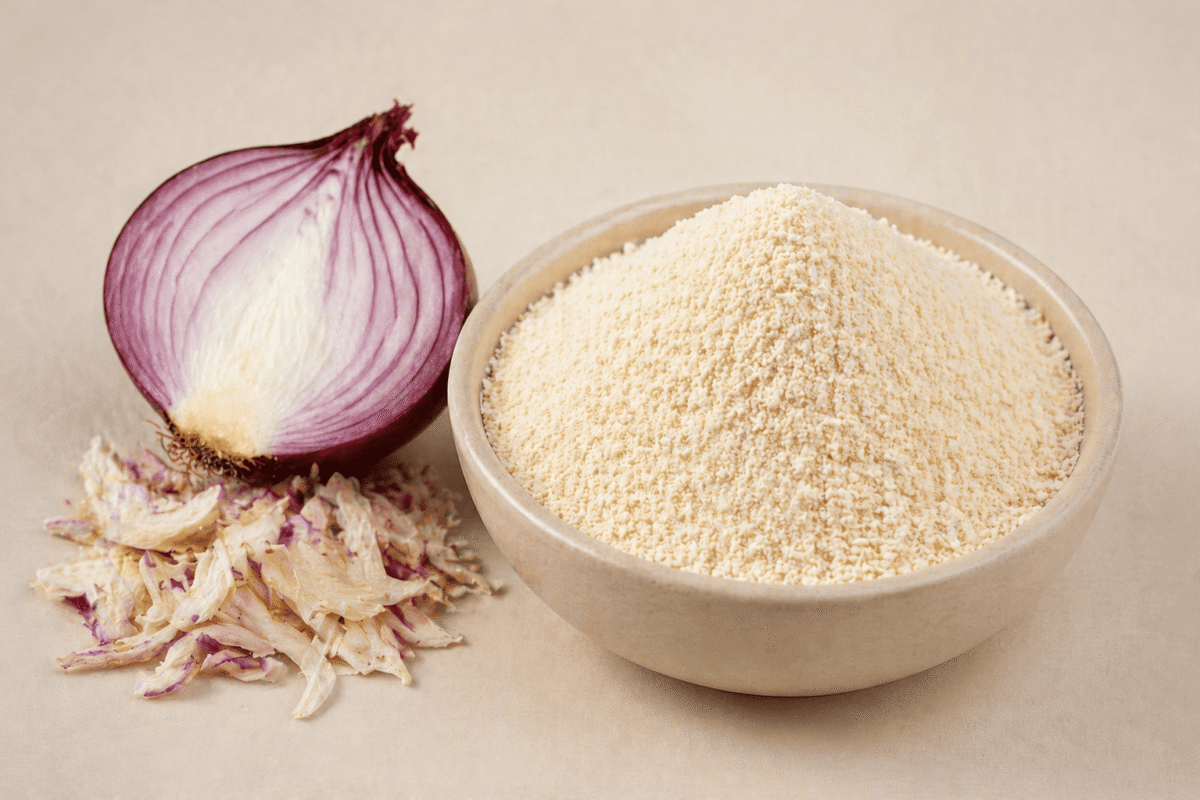
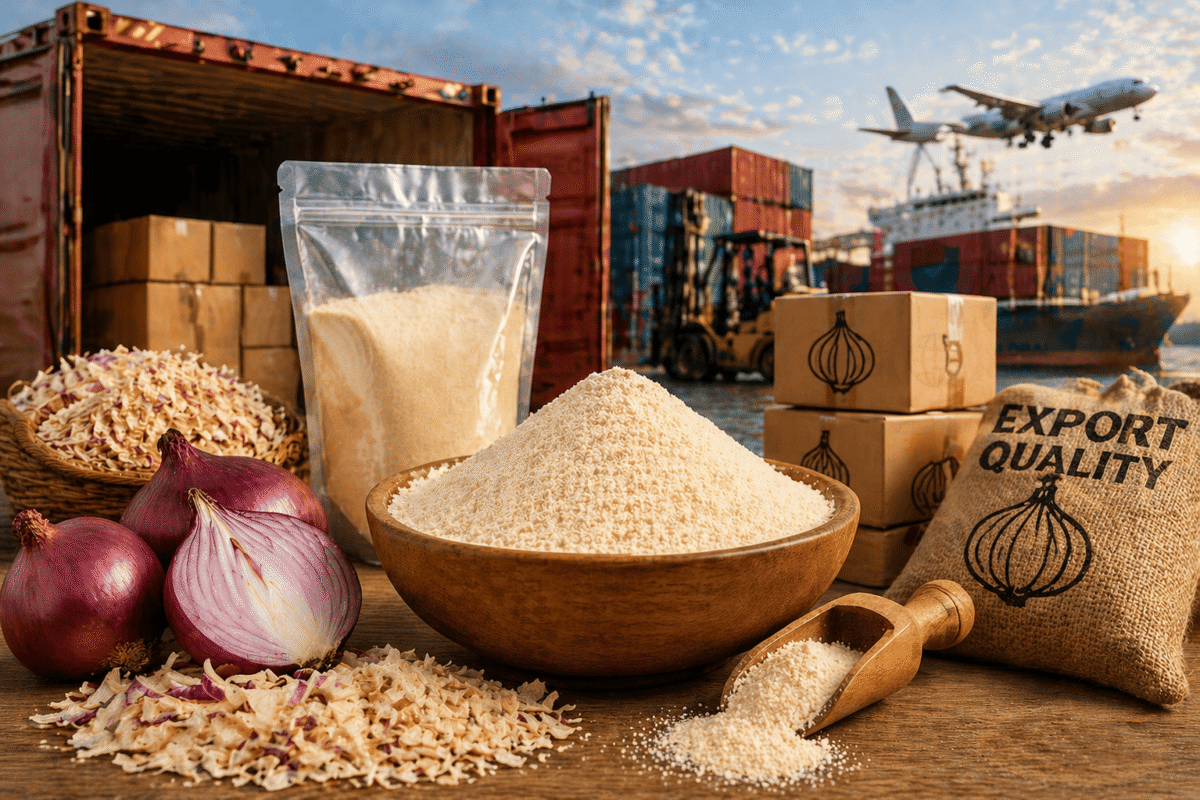
What Happens Between Onion Harvest and Export-Ready Powder Production

If you are involved in export or sourcing, one important question often comes up: what actually happens between the farm and the final export product?

In the case of dry onion powder, the journey is not simple. It involves multiple steps, handling stages, and quality checks. For international buyers, understanding this process is very important because it directly affects:

  • Product quality
  • Consistency
  • Food safety
  • Supply reliability

In today’s global market, buyers are not just interested in the final product they want supply chain transparency. They want to know where the product comes from, how it is processed, and whether every step meets international standards.

In this article, I will explain in a simple and practical way what happens between onion harvest and export-ready powder production, focusing on transparency and real supply chain practices.

Why Supply Chain Transparency Matters

Transparency builds trust. Buyers want to be confident that:

  • Raw materials are sourced properly
  • Processing is hygienic
  • Quality is maintained at every stage
  • No shortcuts are taken

Without transparency:

  • Buyers hesitate to commit
  • Risk perception increases
  • Long-term business becomes difficult

Stage 1: Onion Harvesting at Farm Level

Everything starts at the farm.

What Happens

  • Onions are harvested at full maturity
  • Farmers select crops based on size and quality
  • Initial sorting is done at farm level

Why This Stage Matters

The quality of raw onions directly impacts:

  • Aroma strength
  • Flavor quality
  • Final powder consistency

Poor-quality onions cannot produce premium powder.

Stage 2: Collection and Aggregation

After harvesting, onions are collected and moved to aggregation points.

Process Includes

  • Transport from farms to local markets or collection centers
  • Bulk gathering from multiple farmers
  • Initial grading based on size and condition

Transparency Factor

Buyers often want to know:

  • Source region
  • Farming practices
  • Handling conditions

Reliable sourcing ensures consistent raw material supply.

Stage 3: Storage Before Processing

Onions are not always processed immediately.

Storage Conditions

  • Stored in ventilated warehouses
  • Protected from moisture
  • Managed to prevent spoilage

Risks at This Stage

  • Poor storage can cause rotting
  • Quality degradation affects final product
  • Loss of aroma strength

Why It Matters

Proper storage ensures:

  • Stable raw material quality
  • Continuous production supply

Stage 4: Transportation to Processing Unit

Once ready, onions are transported to processing facilities.

What Happens

  • Bulk transport in controlled conditions
  • Handling to avoid damage
  • Timely delivery to maintain freshness

Transparency Aspect

Professional suppliers maintain:

  • Traceable supply routes
  • Controlled logistics

Stage 5: Raw Material Inspection

Before processing begins, onions are inspected.

Checks Include

  • Quality and freshness
  • Absence of spoilage
  • Size and uniformity

Why It Matters

Only suitable onions move forward for processing. This step filters out low-quality material.

Stage 6: Cleaning and Preparation

At the factory, onions go through preparation.

Process Includes

  • Washing to remove dirt
  • Peeling outer layers
  • Cutting into slices

Purpose

  • Maintain hygiene
  • Prepare for uniform drying
  • Improve processing efficiency

Stage 7: Dehydration Process

This is one of the most critical steps.

What Happens

  • Onion slices are dried using controlled heat
  • Moisture is removed
  • Product becomes stable for storage

Key Focus Areas

  • Temperature control
  • Drying time
  • Maintaining natural color and aroma

Why It Matters

Proper dehydration ensures:

  • Long shelf life
  • Strong flavor retention
  • Prevention of microbial growth

Stage 8: Conversion into Powder

After dehydration, onions are converted into powder.

Process

  • Dried flakes are ground
  • Powder is refined to required mesh size

Importance

  • Uniform particle size
  • Smooth texture
  • Easy use in food production

Stage 9: Quality Control and Testing

Before packaging, the product is tested.

Common Tests

  • Moisture level
  • Microbial safety
  • Color consistency
  • Aroma strength

Transparency Aspect

Buyers may request:

  • Lab reports
  • Batch testing results
  • Quality certifications

Stage 10: Packaging for Export

After approval, powder is packed.

Packaging Process

  • Use of food-grade materials
  • Moisture-proof inner lining
  • Secure sealing

Why It Matters

Packaging protects product during:

  • Storage
  • Shipping
  • Handling

Stage 11: Storage and Dispatch

Final stage before export.

What Happens

  • Product stored in controlled environment
  • Shipment prepared based on order
  • Documentation completed

Transparency Factor

Buyers expect:

  • Clear shipment details
  • Traceable batch information
  • Timely dispatch

Key Points That Ensure Transparency

Throughout the supply chain, transparency depends on:

  • Traceable sourcing
  • Proper storage practices
  • Controlled processing
  • Clear documentation
  • Open communication

Common Weak Points in Supply Chain

Exporters must avoid:

Poor Raw Material Control

Leads to inconsistent products.

Weak Storage Practices

Causes quality degradation.

Lack of Process Control

Affects flavor and safety.

Missing Documentation

Reduces buyer trust.

What Buyers Expect Today

Modern buyers are more informed and demand:

  • Full supply chain visibility
  • Consistent product quality
  • Verified processing standards
  • Reliable delivery

Conclusion

The journey from onion harvest to export-ready powder is a multi-step process that requires control, consistency, and transparency. Each stage from farm to packaging plays a critical role in delivering a high-quality product.

For exporters, maintaining transparency builds trust and strengthens long-term relationships. For buyers, understanding this process helps in selecting the right supplier.

Because in today’s global trade, it’s not just about the final product, it’s about how clearly and reliably that product is produced and delivered.

Why Food Grade Packaging Is Critical in Dry Onion Powder Export Industry

If you are working in export, especially in food ingredients like dry onion powder, one thing you cannot ignore is packaging. Many exporters focus only on product quality, but experienced buyers know that even the best product can lose its value if packaging is not done properly.

In international trade, packaging is not just about covering the product it is about:

  • Protecting quality
  • Maintaining shelf life
  • Preventing contamination
  • Meeting international standards

In this article, I will explain in a simple and practical way why food grade packaging is critical in dry onion powder export, focusing on shelf life and contamination prevention.

Why Packaging Matters in Export

Dry onion powder is a sensitive product. It reacts easily to:

  • Moisture
  • Air exposure
  • Temperature changes

If packaging is weak, the product can:

  • Lose aroma
  • Form lumps
  • Get contaminated
  • Become unsuitable for use

That’s why buyers in international markets pay serious attention to packaging standards.

What “Food Grade Packaging” Actually Means

Food grade packaging is designed specifically for food products.

Key Characteristics

  • Safe for direct food contact
  • Free from harmful chemicals
  • Non-reactive with product
  • Hygienically processed

Why Buyers Demand It

Food manufacturers must follow strict safety standards. If packaging is not food grade:

  • Product may be rejected
  • Import clearance may fail
  • Brand reputation can be damaged

Shelf Life: The Biggest Impact of Packaging

How Packaging Affects Shelf Life

Dry onion powder has a naturally long shelf life but only if stored correctly.

Good packaging helps:

  • Maintain low moisture level
  • Protect from air exposure
  • Preserve aroma and flavor

Risks of Poor Packaging

If packaging is weak:

  • Moisture enters the product
  • Powder becomes clumpy
  • Flavor strength reduces
  • Shelf life decreases

Practical Impact

For buyers:

  • Shorter shelf life means financial loss
  • Product may expire before use

For exporters:

  • Risk of complaints and rejected shipments

Contamination Prevention in Export Supply Chain

Types of Contamination Risks

During export, dry onion powder can be exposed to:

  • Dust and dirt
  • Microbial contamination
  • Foreign particles
  • Chemical exposure

Role of Packaging

Proper packaging acts as a barrier against:

  • External environment
  • Handling during loading/unloading
  • Long shipping journeys

Why It Matters

Food safety is non-negotiable in global markets. Even minor contamination can:

  • Lead to shipment rejection
  • Cause legal issues
  • Damage long-term relationships

Common Packaging Materials Used

Exporters typically use:

Multi-Layer Packaging

  • Outer Kraft paper bags
  • Inner food-grade plastic lining

Key Features

  • Moisture resistance
  • Strong durability
  • Protection during handling

Bulk Packaging Standards

Common formats include:

  • 20kg or 25kg bags
  • Sealed and labeled properly

Importance of Moisture Control

Moisture is the biggest enemy of dry onion powder.

How Packaging Helps

  • Prevents moisture entry
  • Maintains product dryness
  • Protects during humid conditions

Risks Without Moisture Protection

  • Clumping
  • Microbial growth
  • Product spoilage

Handling and Transportation Protection

Dry onion powder goes through a long journey:

  • Factory → Warehouse
  • Warehouse → Port
  • Port → Destination country

Role of Packaging

Strong packaging ensures:

  • Bags don’t tear
  • Product stays intact
  • Quality remains consistent

Buyer Expectations in International Markets

Global buyers expect:

  • Clean and hygienic packaging
  • Proper sealing
  • Food-grade materials
  • Clear labeling

Why This Matters

Buyers often inspect packaging before approving shipments.

If packaging is poor:

  • Trust is reduced
  • Future orders may stop

Compliance with International Standards

Different markets have strict packaging requirements.

What Buyers Check

  • Food safety compliance
  • Material safety
  • Labeling accuracy

Impact on Export

Non-compliant packaging can:

  • Delay customs clearance
  • Lead to rejection
  • Increase costs

Common Mistakes Exporters Make

Using Low-Quality Packaging

This leads to:

  • Damage during transit
  • Quality loss

Ignoring Inner Lining

Without inner protection:

  • Moisture enters easily

Poor Sealing

Weak sealing increases contamination risk.

Inadequate Labeling

Missing information creates compliance issues.

How Exporters Can Improve Packaging

To meet international standards:

Invest in Quality Materials

Use:

  • Strong outer bags
  • High-quality inner liners

Focus on Sealing

Ensure:

  • Proper closure
  • No leakage

Maintain Hygiene

Packaging process should be:

  • Clean
  • Controlled
  • Safe

Follow Buyer Requirements

Different buyers may have specific packaging needs always confirmed before shipment.

What Good Packaging Achieves

Strong packaging ensures:

  • Longer shelf life
  • Better product safety
  • Reduced risk of rejection
  • Strong buyer confidence

Conclusion

Food grade packaging is not optional in the dry onion powder export industry, it is essential. It directly impacts shelf life, product safety, and overall quality.

For exporters, investing in proper packaging means:

  • Protecting product value
  • Reducing risk
  • Building long-term trust with buyers

Because in international trade, it’s not just what you ship, it’s how safely and professionally you deliver it that defines your success.

How Dry Onion Powder Is Processed for Export-Grade Quality (Step-by-Step Process)

If you are working in export or sourcing food ingredients, one important thing to understand is how the product is actually made. In the case of dry onion powder, processing plays a major role in determining quality, purity, aroma, and consistency.

Many buyers focus only on the final product, but experienced importers always ask about the manufacturing process. Why? Because the process directly affects:

  • Flavor strength
  • Shelf life
  • Food safety
  • Batch consistency

In this article, I will explain in a simple and practical way how dry onion powder is processed for export-grade quality, focusing on dehydration, grinding, and quality control.

Why Processing Matters in Export Quality

Dry onion powder is not just dried onions it is a carefully controlled process.

A strong processing system ensures:

  • Consistent color and texture
  • Strong natural aroma
  • Low moisture content
  • Safe and contamination-free product

Without proper processing, even good raw onions can produce poor-quality powder.

Step 1: Raw Onion Selection

Everything starts with raw material.

What Manufacturers Look For

  • Fresh and mature onions
  • Strong natural aroma
  • No spoilage or damage
  • Uniform size and quality

Why It Matters

Good raw onions produce:

  • Better flavor
  • Higher yield
  • Consistent final product

Step 2: Cleaning and Sorting

Once onions arrive at the processing unit, they go through cleaning.

Process Includes

  • Removing dirt and soil
  • Washing thoroughly
  • Sorting damaged or rotten onions

Purpose

  • Ensure hygiene
  • Maintain food safety
  • Improve final product quality

Step 3: Peeling and Cutting

After cleaning, onions are prepared for drying.

What Happens

  • Outer skin is removed
  • Onions are sliced into uniform pieces

Why Uniform Cutting Matters

  • Ensures even drying
  • Prevents over- or under-drying
  • Maintains consistent quality

Step 4: Dehydration (Drying Process)

This is the most critical step in the entire process.

How Dehydration Works

  • Onion slices are placed in drying machines
  • Controlled heat removes moisture
  • Moisture level is reduced significantly

Key Focus Areas

  • Temperature control
  • Drying time
  • Airflow management

Why It Matters

Proper dehydration ensures:

  • Long shelf life
  • Strong aroma retention
  • Prevention of microbial growth

If drying is not controlled:

  • Flavor is lost
  • Color becomes dark
  • Quality drops

Step 5: Cooling and Stabilization

After drying, onions are cooled before further processing.

Purpose

  • Prevent moisture absorption
  • Stabilize product quality
  • Prepare for grinding

Step 6: Grinding into Powder

Once dried, onions are converted into powder.

Grinding Process

  • Dehydrated onion flakes are fed into grinders
  • Machines convert them into fine powder
  • Mesh size is controlled based on requirement

Mesh Size Importance

Buyers usually require:

  • Fine and uniform powder
  • Consistent particle size

Why It Matters

Proper grinding ensures:

  • Smooth blending in food products
  • Consistent texture
  • Better usability

Step 7: Sieving and Grading

After grinding, powder is passed through sieves.

Purpose

  • Remove large particles
  • Ensure uniform mesh size
  • Improve product consistency

Result

  • Clean, fine powder
  • Standardized quality

Step 8: Quality Control Testing

Before packaging, the product is tested.

Common Tests Include

  • Moisture level
  • Microbial safety
  • Color consistency
  • Aroma strength

Why It Matters

This step ensures:

  • Product meets export standards
  • Buyer requirements are fulfilled
  • Risk of rejection is minimized

Step 9: Packaging for Export

Packaging is the final step before shipment.

Export Packaging Standards

  • Food-grade bags
  • Moisture-proof inner lining
  • Secure sealing

Common Packaging Sizes

  • Bulk bags for industrial use
  • Customized packaging if required

Why It Matters

Good packaging:

  • Protects product during transit
  • Maintains quality
  • Prevents contamination

Step 10: Storage and Dispatch

After packaging, the product is stored before shipment.

Storage Conditions

  • Cool and dry environment
  • Protection from moisture
  • Proper stacking

Final Dispatch

  • Shipment prepared as per order
  • Documentation completed
  • Goods transported to port

Key Factors That Define Export-Grade Quality

From start to finish, quality depends on:

  • Raw material selection
  • Controlled dehydration
  • Accurate grinding
  • Strong quality checks
  • Proper packaging

Each step must be consistent.

Common Processing Mistakes to Avoid

Overheating During Drying

  • Reduces aroma
  • Darkens color

Uneven Cutting

  • Causes inconsistent drying

Poor Grinding Control

  • Leads to uneven texture

Weak Quality Checks

  • Increases risk of rejection

What Buyers Expect from Processed Product

International buyers expect:

  • Clean and pure onion powder
  • Strong natural aroma
  • Fine and uniform mesh
  • Low moisture content
  • Consistent quality across batches

Conclusion

Dry onion powder processing for export-grade quality is a step-by-step controlled system. Every stage from raw onion selection to final packaging plays a role in delivering a high-quality product.

For exporters, understanding and maintaining this process is essential to compete in international markets. For buyers, knowing the process helps in evaluating suppliers more effectively.

Because in global trade, quality is not created at the end it is built through every step of the process.

Common Mistakes Importers Make When Sourcing Dry Onion Powder Globally

If you are importing dry onion powder for food manufacturing, retail, or distribution, one thing is clear: small mistakes can lead to big losses. In international sourcing, especially in products like dry onion powder, quality, consistency, and supplier reliability are critical.

Many importersespecially new onesfocus only on finding a supplier quickly. But experienced buyers know that sourcing is not just about buying, it is about risk management, quality control, and long-term planning.

In this article, I will explain in a simple and practical way the most common mistakes importers make when sourcing dry onion powder globally, and how you can avoid them to protect your business.

Why Mistakes Happen in Global Sourcing

Importing involves multiple layers:

  • Supplier selection
  • Quality verification
  • Logistics
  • Documentation
  • Payment terms

Mistake 1: Focusing Only on Low Cost

What Happens

Many importers choose suppliers based only on the lowest offer.

Why It’s a Problem

Low-cost products often come with:

  • Weak aroma
  • Poor quality raw material
  • Inconsistent batches
  • Hidden additives

Better Approach

Focus on:

  • Quality consistency
  • Supplier reliability
  • Long-term value

Because in the food business, quality issues cost more than savings.

Mistake 2: Skipping Proper Sample Testing

What Happens

Some buyers approve suppliers without testing samples properly.

Why It’s Risky

Without testing:

  • Flavor may not match requirement
  • Texture may be unsuitable
  • Product may fail in real applications

Better Approach

Always:

  • Test samples in actual production
  • Check aroma, color, and consistency
  • Evaluate storage stability

Mistake 3: Ignoring Supplier Credibility

What Happens

Importers sometimes trust suppliers without verification.

Risks

  • Delayed shipments
  • Poor documentation
  • Inconsistent supply

Better Approach

Verify:

  • Export experience
  • Certifications
  • Production capacity

Mistake 4: Not Checking Consistency

What Happens

Buyers approve one good sample but don’t check consistency.

Why It’s a Problem

Bulk shipments may:

  • Differ from sample
  • Vary in color and flavor
  • Affect final product quality

Better Approach

Ensure:

  • Batch-to-batch consistency
  • Standardized production process
  • Supplier quality control system

Mistake 5: Weak Understanding of Specifications

What Happens

Buyers do not clearly define product specifications.

Risks

  • Receiving wrong mesh size
  • High moisture content
  • Lower purity

Better Approach

Clearly define:

  • Mesh size
  • Moisture level
  • Purity standards
  • Packaging requirements

Mistake 6: Poor Communication with Supplier

What Happens

Lack of clear communication creates confusion.

Risks

  • Incorrect orders
  • Delays
  • Misunderstanding of requirements

Better Approach

Maintain:

  • Clear written communication
  • Detailed specifications
  • Regular updates

Mistake 7: Ignoring Packaging Quality

What Happens

Buyers focus on the product but ignore packaging.

Risks

  • Moisture damage
  • Contamination
  • Product clumping

Better Approach

Ensure:

  • Food-grade packaging
  • Moisture-resistant materials
  • Proper sealing

Mistake 8: Not Understanding Logistics and Lead Time

What Happens

Importers underestimate shipping timelines.

Risks

  • Stock shortages
  • Production delays
  • Increased costs

Better Approach

Plan for:

  • Production time
  • Shipping duration
  • Customs clearance

Mistake 9: Choosing Wrong Payment Terms

What Happens

Importers agree to risky or unclear payment terms.

Risks

  • Financial loss
  • Delayed shipments
  • Disputes

Better Approach

Choose:

  • Secure payment methods
  • Balanced risk structure
  • Terms based on supplier trust

Mistake 10: Skipping Trial Orders

What Happens

Some buyers go directly for large orders.

Why It’s Risky

  • No real shipment testing
  • High financial exposure
  • No proof of consistency

Better Approach

Always start with:

  • Small trial order
  • Evaluate full process
  • Scale gradually

Mistake 11: Ignoring Certifications and Compliance

What Happens

Buyers do not check regulatory requirements.

Risks

  • Shipment rejection
  • Legal issues
  • Market access problems

Better Approach

Ensure supplier meets:

  • Required certifications
  • Market compliance standards
  • Documentation requirements

Mistake 12: Lack of Long-Term Strategy

What Happens

Importers focus only on one-time purchase.

Risks

  • Inconsistent supply
  • Frequent supplier changes
  • Higher operational cost

Better Approach

Build:

  • Long-term supplier relationships
  • Stable sourcing strategy
  • Reliable supply chain

Simple Risk Prevention Checklist

Before placing an order, confirm:

  • Sample approved
  • Supplier verified
  • Specifications clear
  • Packaging checked
  • Payment terms defined
  • Trial order completed

What Smart Importers Do Differently

Experienced importers:

  • Focus on quality, not just cost
  • Test before scaling
  • Build long-term partnerships
  • Communicate clearly
  • Plan ahead

Conclusion

Sourcing dry onion powder globally is not difficult but it requires the right approach. Most problems happen because of simple mistakes that can be avoided with proper planning and evaluation.

By understanding common mistakes and focusing on risk prevention, importers can:

  • Avoid quality issues
  • Reduce financial risk
  • Build reliable supply chains

Because in international trade, success is not about finding a supplier, it’s about finding the right supplier and working with them the right way.