
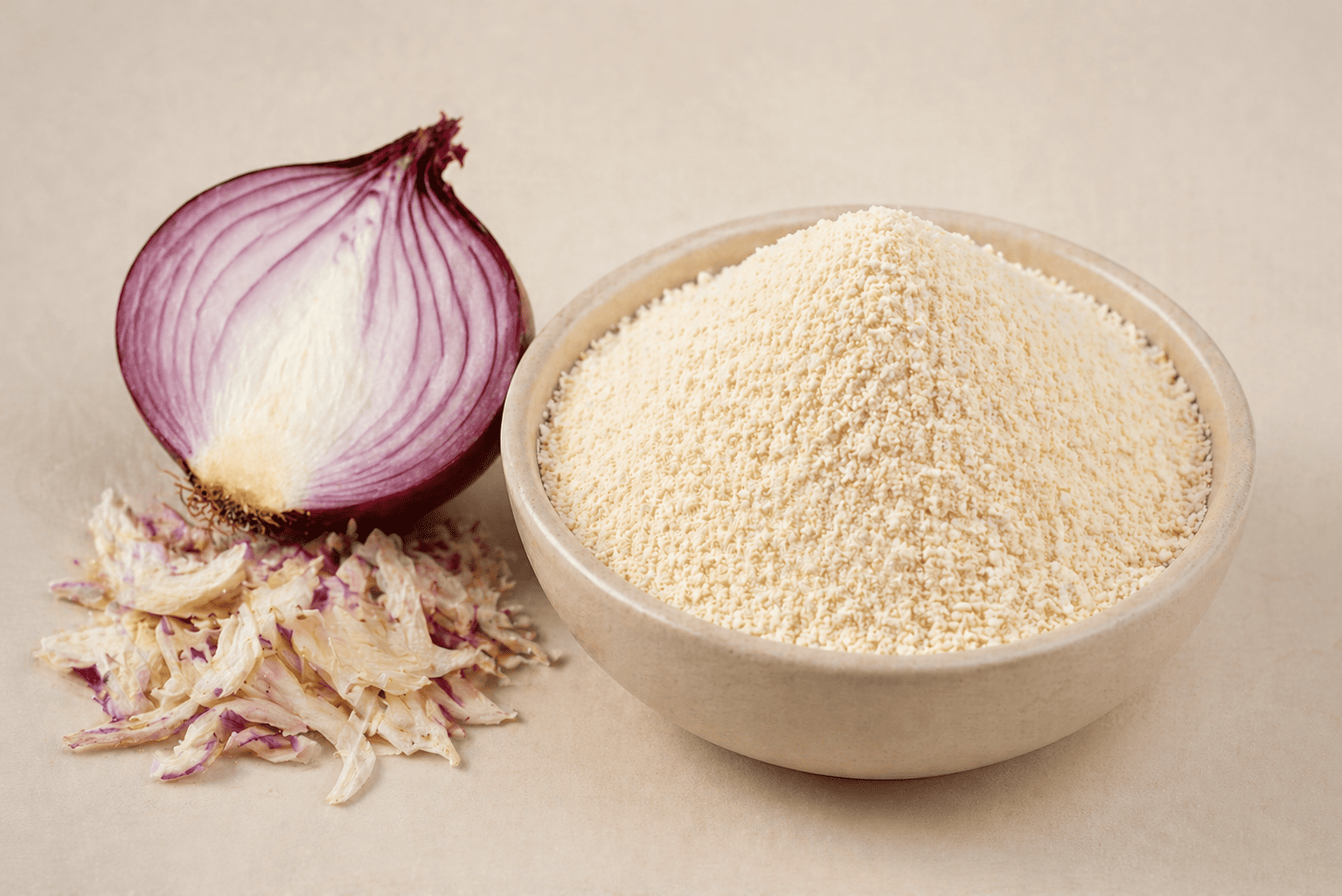
If you are involved in export or sourcing, one important question often comes up: what actually happens between the farm and the final export product?
In the case of dry onion powder, the journey is not simple. It involves multiple steps, handling stages, and quality checks. For international buyers, understanding this process is very important because it directly affects:
- Product quality
- Consistency
- Food safety
- Supply reliability
In today’s global market, buyers are not just interested in the final product they want supply chain transparency. They want to know where the product comes from, how it is processed, and whether every step meets international standards.
In this article, I will explain in a simple and practical way what happens between onion harvest and export-ready powder production, focusing on transparency and real supply chain practices.
Why Supply Chain Transparency Matters
Transparency builds trust. Buyers want to be confident that:
- Raw materials are sourced properly
- Processing is hygienic
- Quality is maintained at every stage
- No shortcuts are taken
Without transparency:
- Buyers hesitate to commit
- Risk perception increases
- Long-term business becomes difficult
Stage 1: Onion Harvesting at Farm Level
Everything starts at the farm.
What Happens
- Onions are harvested at full maturity
- Farmers select crops based on size and quality
- Initial sorting is done at farm level
Why This Stage Matters
The quality of raw onions directly impacts:
- Aroma strength
- Flavor quality
- Final powder consistency
Poor-quality onions cannot produce premium powder.
Stage 2: Collection and Aggregation
After harvesting, onions are collected and moved to aggregation points.
Process Includes
- Transport from farms to local markets or collection centers
- Bulk gathering from multiple farmers
- Initial grading based on size and condition
Transparency Factor
Buyers often want to know:
- Source region
- Farming practices
- Handling conditions
Reliable sourcing ensures consistent raw material supply.
Stage 3: Storage Before Processing
Onions are not always processed immediately.
Storage Conditions
- Stored in ventilated warehouses
- Protected from moisture
- Managed to prevent spoilage
Risks at This Stage
- Poor storage can cause rotting
- Quality degradation affects final product
- Loss of aroma strength
Why It Matters
Proper storage ensures:
- Stable raw material quality
- Continuous production supply
Stage 4: Transportation to Processing Unit
Once ready, onions are transported to processing facilities.
What Happens
- Bulk transport in controlled conditions
- Handling to avoid damage
- Timely delivery to maintain freshness
Transparency Aspect
Professional suppliers maintain:
- Traceable supply routes
- Controlled logistics
Stage 5: Raw Material Inspection
Before processing begins, onions are inspected.
Checks Include
- Quality and freshness
- Absence of spoilage
- Size and uniformity
Why It Matters
Only suitable onions move forward for processing. This step filters out low-quality material.
Stage 6: Cleaning and Preparation
At the factory, onions go through preparation.
Process Includes
- Washing to remove dirt
- Peeling outer layers
- Cutting into slices
Purpose
- Maintain hygiene
- Prepare for uniform drying
- Improve processing efficiency
Stage 7: Dehydration Process
This is one of the most critical steps.
What Happens
- Onion slices are dried using controlled heat
- Moisture is removed
- Product becomes stable for storage
Key Focus Areas
- Temperature control
- Drying time
- Maintaining natural color and aroma
Why It Matters
Proper dehydration ensures:
- Long shelf life
- Strong flavor retention
- Prevention of microbial growth
Stage 8: Conversion into Powder
After dehydration, onions are converted into powder.
Process
- Dried flakes are ground
- Powder is refined to required mesh size
Importance
- Uniform particle size
- Smooth texture
- Easy use in food production
Stage 9: Quality Control and Testing
Before packaging, the product is tested.
Common Tests
- Moisture level
- Microbial safety
- Color consistency
- Aroma strength
Transparency Aspect
Buyers may request:
- Lab reports
- Batch testing results
- Quality certifications
Stage 10: Packaging for Export
After approval, powder is packed.
Packaging Process
- Use of food-grade materials
- Moisture-proof inner lining
- Secure sealing
Why It Matters
Packaging protects product during:
- Storage
- Shipping
- Handling
Stage 11: Storage and Dispatch
Final stage before export.
What Happens
- Product stored in controlled environment
- Shipment prepared based on order
- Documentation completed
Transparency Factor
Buyers expect:
- Clear shipment details
- Traceable batch information
- Timely dispatch
Key Points That Ensure Transparency
Throughout the supply chain, transparency depends on:
- Traceable sourcing
- Proper storage practices
- Controlled processing
- Clear documentation
- Open communication
Common Weak Points in Supply Chain
Exporters must avoid:
Poor Raw Material Control
Leads to inconsistent products.
Weak Storage Practices
Causes quality degradation.
Lack of Process Control
Affects flavor and safety.
Missing Documentation
Reduces buyer trust.
What Buyers Expect Today
Modern buyers are more informed and demand:
- Full supply chain visibility
- Consistent product quality
- Verified processing standards
- Reliable delivery
Conclusion
The journey from onion harvest to export-ready powder is a multi-step process that requires control, consistency, and transparency. Each stage from farm to packaging plays a critical role in delivering a high-quality product.
For exporters, maintaining transparency builds trust and strengthens long-term relationships. For buyers, understanding this process helps in selecting the right supplier.
Because in today’s global trade, it’s not just about the final product, it’s about how clearly and reliably that product is produced and delivered.