
Introduction
When people see a box of exported mangoes in Dubai, London, or Riyadh, they usually think the process is simple: farmers pick mangoes, pack them, and ship them.
But the reality is very different.
Between harvest and shipment, there is a full chain of carefully controlled steps that decide whether mangoes will arrive fresh, acceptable, and profitable-or rejected and wasted.
This behind-the-scenes phase is where exporters actually make or lose money. It includes sorting, grading, cooling, inspection, packing, documentation, and logistics coordination-all happening in a very short time window.
Let’s break down exactly what happens after mangoes are harvested and before they leave for international markets.
Step 1 – Harvesting at the Right Time
Timing the Harvest Carefully
Mangoes are not picked randomly. Harvest timing is based on:
- Maturity level
- Variety type (Chaunsa, Sindhri, etc.)
- Target export market
If harvested too early, mangoes won’t ripen properly. If too late, they spoil during transport.
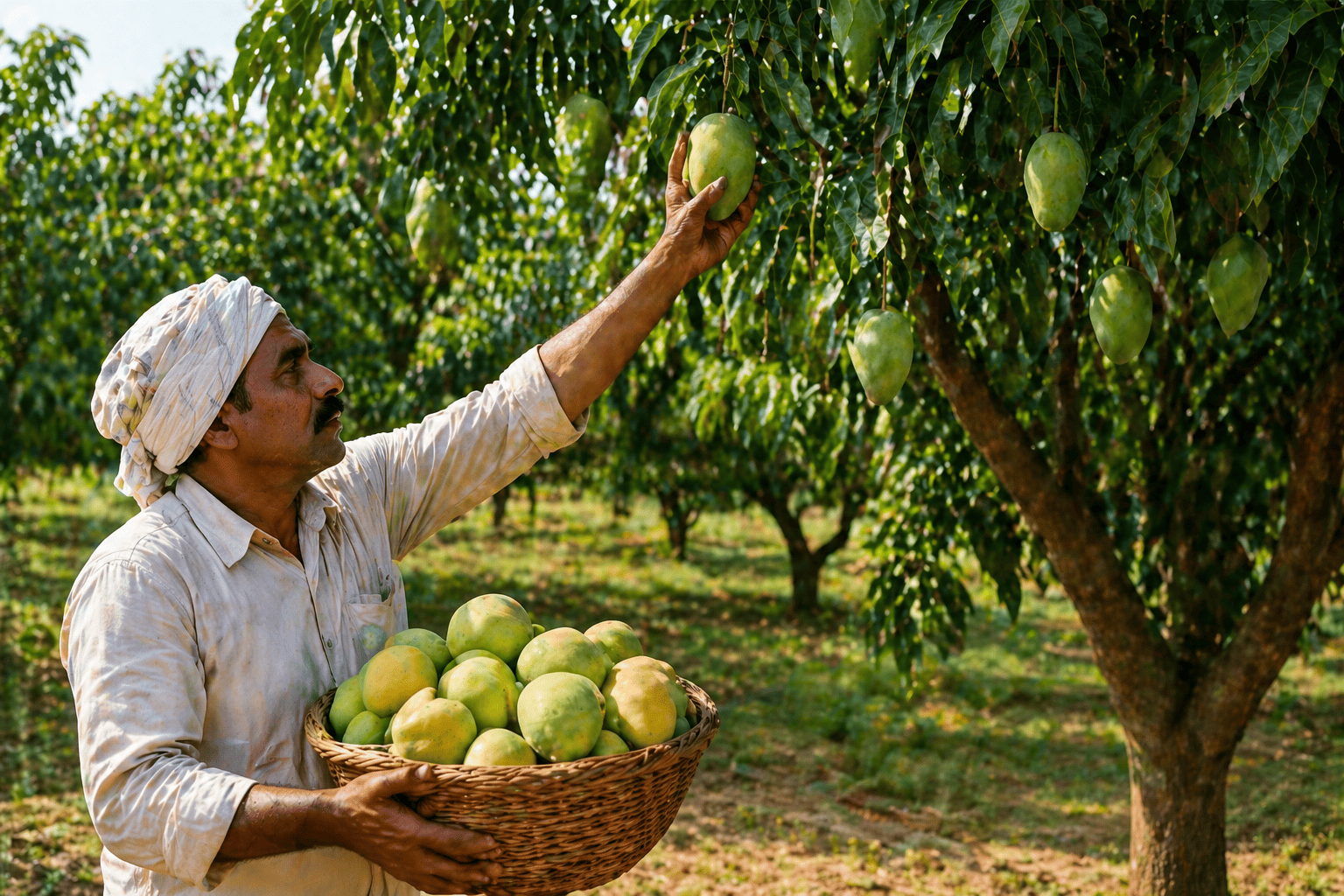
Manual Picking Process
Mangoes are hand-picked using:
- Long picking poles
- Soft baskets or crates
- Skilled laborers trained to avoid damage
Workers ensure:
- No dropping of fruit
- No skin scratches
- Proper stem cutting
This is the first quality control point.
Step 2 – Immediate Field Handling
Preventing Heat Damage
Once harvested, mangoes are sensitive to heat. In hot climates, even 30–60 minutes of exposure can start affecting quality.
So mangoes are quickly moved to:
- Shaded collection areas
- Temporary field packing spots
Initial Visual Sorting
At this stage, rough sorting begins:
- Good fruit separated
- Damaged or diseased fruit removed
- Undersized mangoes filtered out
This prevents waste of packing resources later.
Step 3 – Transport to Packing House
Careful Loading Process
Mangoes are transported in covered vehicles to avoid sun exposure.
Key practices include:
- Soft handling during loading
- Avoiding overstacking
- Minimizing vibration damage
Time-Sensitive Movement
This transfer is usually fast because:
- Heat exposure reduces shelf life
- Ripening process begins immediately after harvest
Speed is critical.
Step 4 – Washing and Pre-Treatment
Cleaning the Fruit
At the packing facility, mangoes are washed to remove:
- Dust
- Latex stains
- Field residue
This improves appearance and hygiene.
Post-Harvest Treatment (If Applied)
Some exporters use treatments like:
- Hot water treatment (for export compliance)
- Fungicide dips (for shelf life protection)
These steps help reduce spoilage during long transport.
Step 5 – Grading and Sorting (Most Important Stage)
Size-Based Grading
Mangoes are sorted into categories such as:
- Large
- Medium
- Small
Uniformity is critical for export cartons.
Quality-Based Selection
Beyond size, mangoes are checked for:
- Shape
- Skin color
- Bruises or blemishes
- Internal firmness
Only export-grade fruit moves forward.
Why This Step Matters So Much
This is where exporters either build or lose buyer trust.
A small inconsistency in grading can lead to:
- Shipment rejection
- Price reduction
- Loss of repeat orders
Step 6 – Pre-Cooling Process
Removing Field Heat
After grading, mangoes are placed in cold storage rooms to remove heat absorbed during harvesting.
Typical conditions:
- Temperature: around 12°C–13°C
- Controlled humidity levels
Why Pre-Cooling Is Critical
Without pre-cooling:
- Mangoes ripen too fast
- Shelf life reduces significantly
- Export risk increases
This step stabilizes fruit before packing.
Step 7 – Export Packaging
Carton Selection
Mangoes are packed in export-grade cartons designed for:
- Ventilation
- Strength
- Stackability
Protective Layering
Inside cartons:
- Foam sheets or paper wrapping
- Careful spacing between fruits
- Grade-based arrangement
This reduces friction damage during transport.
Labeling and Traceability
Each box includes:
- Variety name
- Grade and size
- Farm or exporter details
- Destination information
This ensures full traceability in international markets.
Step 8 – Quality Inspection Before Shipment
Final Export Check
Before loading, a final inspection is done.
Inspectors check:
- Uniformity
- Packaging strength
- Temperature condition
- Overall appearance
Buyer or Third-Party Inspection (Sometimes)
For large shipments, buyers may send inspectors to verify quality before dispatch.
This is common in:
- UAE retail contracts
- European supermarket supply chains
Step 9 – Documentation Preparation
Export Paperwork
No shipment moves without documents such as:
- Phytosanitary certificate
- Invoice and packing list
- Certificate of origin
- Export declaration
Compliance Requirements
Different markets require different standards:
- EU: strict pesticide residue compliance
- Middle East: general quality and freshness focus
Step 10 – Cold Chain Coordination
Temperature Protection Before Shipment
Mangoes are kept in controlled environments until loading.
This ensures:
- No heat exposure
- Stable ripening process
Transport to Airport or Port
Refrigerated trucks move mangoes to:
- Airports (for air freight)
- Sea ports (for container loading)
Step 11 – Final Shipment Loading
Careful Container Loading
Mango cartons are loaded into:
- Air cargo pallets
- Refrigerated sea containers (reefers)
Temperature Monitoring Begins
Once loaded:
- Temperature is continuously monitored
- Humidity levels are controlled
This ensures safe transit.
What Buyers Don’t See Behind the Scenes
Most buyers only see the final box-but behind it is:
- Skilled labor coordination
- Fast-paced logistics
- Quality control teams
- Cold chain management
- Documentation experts
Everything happens within a very short time window to protect freshness.
Common Mistakes During This Stage
- Delayed transport from farm to packing house
- Poor grading consistency
- Skipping pre-cooling
- Weak packaging materials
- Documentation errors
- Lack of temperature control
Even one mistake can affect the entire shipment.
Why This Stage Decides Export Success
The period between harvest and shipment is where:
- Quality is protected or lost
- Buyer trust is built or broken
- Profit margins are decided
A good harvest is not enough. Execution during this phase determines success in international markets.
Conclusion
Behind every exported mango box is a detailed, fast-moving system that ensures freshness, quality, and compliance.
From harvesting to grading, cooling, packing, and final shipment, every step is designed to protect the fruit and meet strict global expectations.
For exporters, this stage is not just logistics-it is the core of the entire business. Those who manage it well build strong international buyers, repeat orders, and long-term success in the global mango trade.