
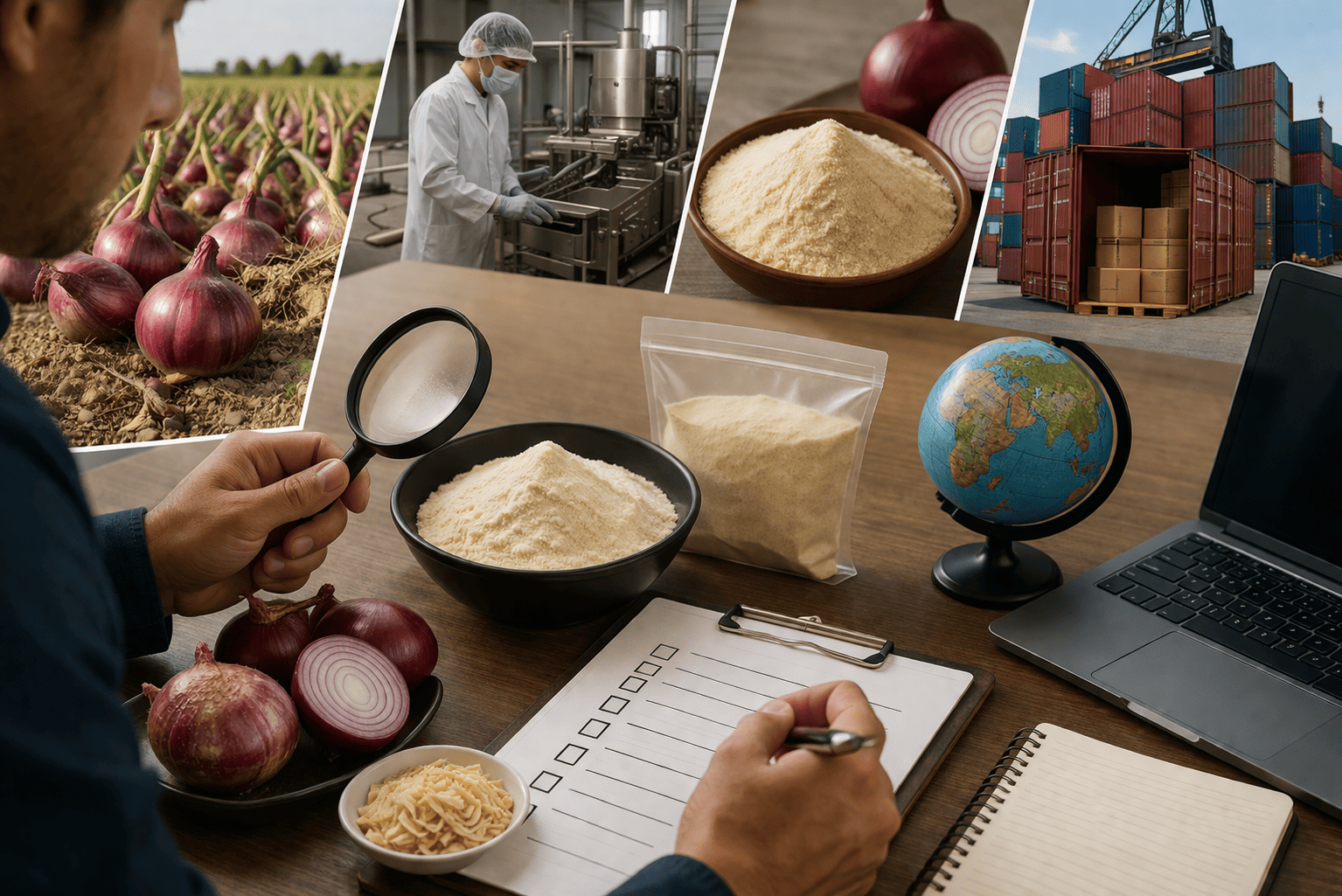
If you are working in export or sourcing food ingredients, one important thing to understand is how the product is actually made. In the case of dry onion powder, processing plays a major role in determining quality, purity, aroma, and consistency.
Many buyers focus only on the final product, but experienced importers always ask about the manufacturing process. Why? Because the process directly affects:
- Flavor strength
- Shelf life
- Food safety
- Batch consistency
In this article, I will explain in a simple and practical way how dry onion powder is processed for export-grade quality, focusing on dehydration, grinding, and quality control.
Why Processing Matters in Export Quality
Dry onion powder is not just dried onions it is a carefully controlled process.
A strong processing system ensures:
- Consistent color and texture
- Strong natural aroma
- Low moisture content
- Safe and contamination-free product
Without proper processing, even good raw onions can produce poor-quality powder.
Step 1: Raw Onion Selection
Everything starts with raw material.
What Manufacturers Look For
- Fresh and mature onions
- Strong natural aroma
- No spoilage or damage
- Uniform size and quality
Why It Matters
Good raw onions produce:
- Better flavor
- Higher yield
- Consistent final product
Step 2: Cleaning and Sorting
Once onions arrive at the processing unit, they go through cleaning.
Process Includes
- Removing dirt and soil
- Washing thoroughly
- Sorting damaged or rotten onions
Purpose
- Ensure hygiene
- Maintain food safety
- Improve final product quality
Step 3: Peeling and Cutting
After cleaning, onions are prepared for drying.
What Happens
- Outer skin is removed
- Onions are sliced into uniform pieces
Why Uniform Cutting Matters
- Ensures even drying
- Prevents over- or under-drying
- Maintains consistent quality
Step 4: Dehydration (Drying Process)
This is the most critical step in the entire process.
How Dehydration Works
- Onion slices are placed in drying machines
- Controlled heat removes moisture
- Moisture level is reduced significantly
Key Focus Areas
- Temperature control
- Drying time
- Airflow management
Why It Matters
Proper dehydration ensures:
- Long shelf life
- Strong aroma retention
- Prevention of microbial growth
If drying is not controlled:
- Flavor is lost
- Color becomes dark
- Quality drops
Step 5: Cooling and Stabilization
After drying, onions are cooled before further processing.
Purpose
- Prevent moisture absorption
- Stabilize product quality
- Prepare for grinding
Step 6: Grinding into Powder
Once dried, onions are converted into powder.
Grinding Process
- Dehydrated onion flakes are fed into grinders
- Machines convert them into fine powder
- Mesh size is controlled based on requirement
Mesh Size Importance
Buyers usually require:
- Fine and uniform powder
- Consistent particle size
Why It Matters
Proper grinding ensures:
- Smooth blending in food products
- Consistent texture
- Better usability
Step 7: Sieving and Grading
After grinding, powder is passed through sieves.
Purpose
- Remove large particles
- Ensure uniform mesh size
- Improve product consistency
Result
- Clean, fine powder
- Standardized quality
Step 8: Quality Control Testing
Before packaging, the product is tested.
Common Tests Include
- Moisture level
- Microbial safety
- Color consistency
- Aroma strength
Why It Matters
This step ensures:
- Product meets export standards
- Buyer requirements are fulfilled
- Risk of rejection is minimized
Step 9: Packaging for Export
Packaging is the final step before shipment.
Export Packaging Standards
- Food-grade bags
- Moisture-proof inner lining
- Secure sealing
Common Packaging Sizes
- Bulk bags for industrial use
- Customized packaging if required
Why It Matters
Good packaging:
- Protects product during transit
- Maintains quality
- Prevents contamination
Step 10: Storage and Dispatch
After packaging, the product is stored before shipment.
Storage Conditions
- Cool and dry environment
- Protection from moisture
- Proper stacking
Final Dispatch
- Shipment prepared as per order
- Documentation completed
- Goods transported to port
Key Factors That Define Export-Grade Quality
From start to finish, quality depends on:
- Raw material selection
- Controlled dehydration
- Accurate grinding
- Strong quality checks
- Proper packaging
Each step must be consistent.
Common Processing Mistakes to Avoid
Overheating During Drying
- Reduces aroma
- Darkens color
Uneven Cutting
- Causes inconsistent drying
Poor Grinding Control
- Leads to uneven texture
Weak Quality Checks
- Increases risk of rejection
What Buyers Expect from Processed Product
International buyers expect:
- Clean and pure onion powder
- Strong natural aroma
- Fine and uniform mesh
- Low moisture content
- Consistent quality across batches
Conclusion
Dry onion powder processing for export-grade quality is a step-by-step controlled system. Every stage from raw onion selection to final packaging plays a role in delivering a high-quality product.
For exporters, understanding and maintaining this process is essential to compete in international markets. For buyers, knowing the process helps in evaluating suppliers more effectively.
Because in global trade, quality is not created at the end it is built through every step of the process.