
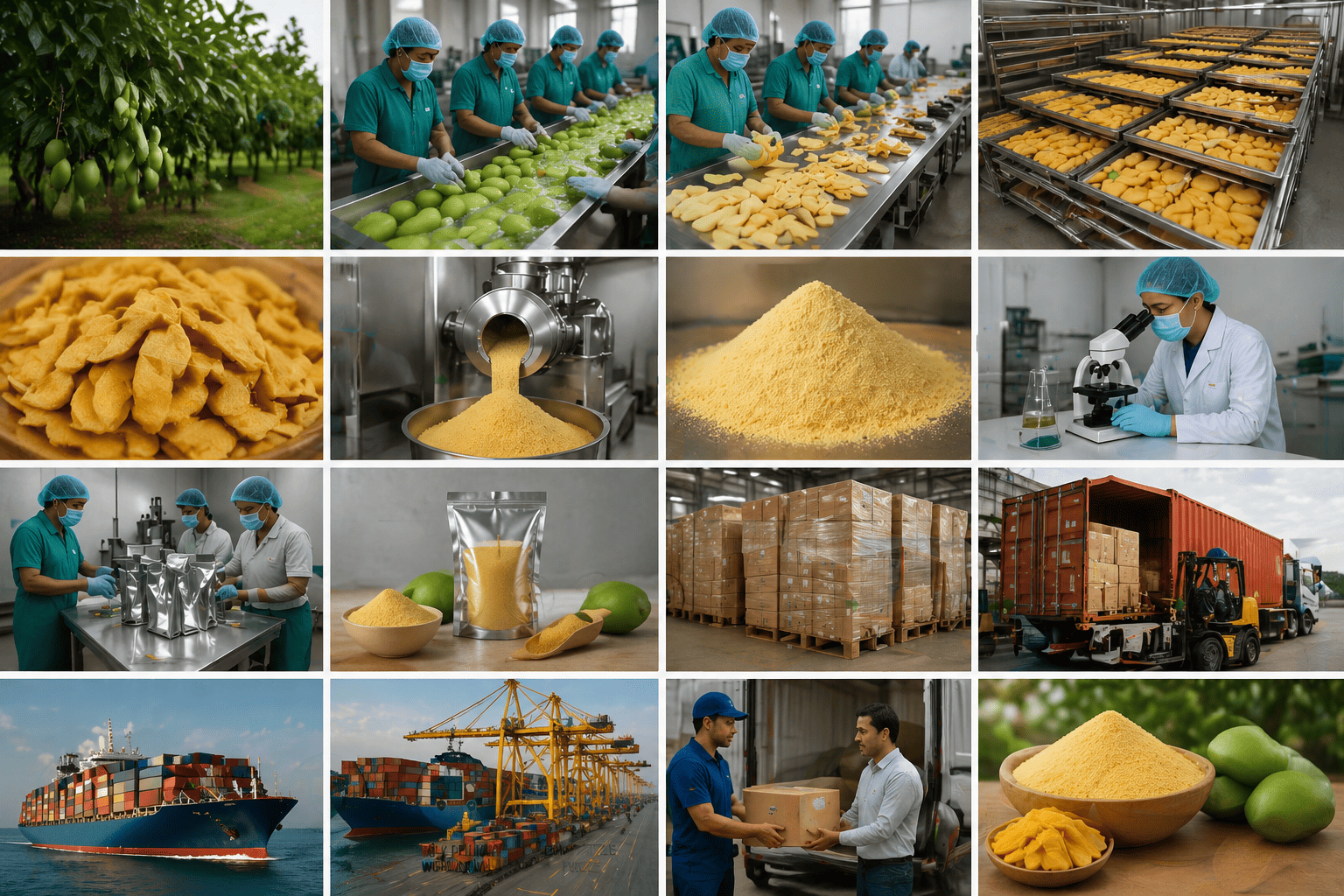
Introduction
Global food brands, supermarket chains, and large distributors have strict expectations when sourcing dry mango powder. Unlike local buyers, international companies operate under regulated food systems where even minor deviations in quality or compliance can lead to rejected shipments or contract termination.
For suppliers, understanding these expectations is essential to enter and sustain a presence in export markets such as the USA, UK, EU, and the Middle East.
Core Expectations of Global Buyers
International food companies evaluate suppliers on four key pillars:
- Compliance with food safety regulations
- Product consistency across batches
- Valid certifications and documentation
- Stable supply chain performance
These four factors determine whether a supplier becomes a long-term partner or remains a one-time vendor.
Compliance: The First Gate of Approval
Compliance is the most critical requirement for global food brands.
Food Safety Regulations
Importers require suppliers to meet international standards such as:
- FDA (United States)
- EU Food Safety Regulations
- UK Food Standards Agency rules
Hygiene and Processing Standards
Factories must follow:
- HACCP systems (Hazard Analysis Critical Control Point)
- GMP (Good Manufacturing Practices)
- Hygienic drying and grinding processes
Traceability Requirements
Buyers demand full traceability:
- Farm origin of mangoes
- Processing batch records
- Storage and packaging history
Without compliance, even competitive pricing is irrelevant.
Consistency: The Most Critical Quality Factor
Global brands prioritize consistency over price.
Why Consistency Matters
A food brand cannot risk flavor variation in:
- Spice blends
- Sauces
- Ready meals
- Snack coatings
Even a 5-10% variation in acidity or color can affect final product taste.
Key Consistency Parameters
Importers monitor:
- Color uniformity (natural golden-brown shade)
- Moisture level (typically below 10%)
- Particle size uniformity
- Aroma stability
Batch Control Systems
Leading suppliers implement:
- Standard operating procedures (SOPs)
- Lab testing for every batch
- Controlled drying temperatures
Certifications: Proof of Trust and Safety
Certifications act as trust signals in international trade.
Mandatory Certifications for Export Markets
Most global buyers require:
- HACCP Certification
- ISO 22000 Food Safety Management
- FSSAI (for Indian subcontinent suppliers)
- Organic Certification (if applicable)
Additional Buyer-Specific Certifications
Depending on market:
- Kosher certification (USA, EU)
- Halal certification (Middle East)
- Non-GMO verification
Why Certifications Matter
Certified suppliers:
- Reduce buyer risk
- Speed up approval processes
- Improve chances of long-term contracts
In many cases, certified suppliers are preferred even at a 5-15% higher price point.
Supply Stability: Ensuring Continuous Availability
Global food brands operate on fixed production schedules.
Importance of Supply Reliability
A delay in raw material can disrupt:
- Factory production lines
- Retail supply chains
- Seasonal product launches
Key Stability Expectations
Buyers expect suppliers to guarantee:
- Year-round availability
- Backup stock capacity
- Reliable harvest sourcing
- Fast replenishment cycles
Production Planning Alignment
Large distributors often plan procurement 3-6 months in advance, so suppliers must align production capacity accordingly.
Packaging and Logistics Standards
Even high-quality products can be rejected due to poor logistics handling.
Packaging Requirements
Dry mango powder must be:
- Moisture-proof sealed
- Food-grade packed
- Vacuum or nitrogen flushed (for premium buyers)
- Clearly labeled with batch codes
Shipping Standards
Importers expect:
- On-time delivery performance above 95%
- Proper export documentation
- Temperature and humidity control during transit
Shelf Life Requirement
Most buyers demand:
- 12 -24 months shelf life minimum
- Stable quality during storage and shipping
Quality Benchmarks Used by Importers
Global buyers evaluate dry mango powder using strict measurable KPIs:
Physical Standards
- Moisture: ≤10%
- Color: Natural yellow-brown
- Free from visible impurities
Microbiological Standards
- E. coli: Absent
- Salmonella: Absent
- Total plate count: within safe limits
Sensory Standards
- Balanced sourness
- Natural mango aroma
- No burnt or off-flavor notes
Procurement KPIs Used by Global Brands
Large food companies track supplier performance using KPIs such as:
- On-time delivery rate (target: 95%+)
- Defect rate (target: <2%)
- Complaint ratio per shipment
- Price stability index
- Certification compliance score
Suppliers who consistently meet KPIs are prioritized for repeat contracts.
Common Reasons Suppliers Fail International Expectations
- Inconsistent Product Quality
Batch variation leads to immediate rejection.
- Missing or Expired Certifications
Even small documentation gaps can delay imports.
- Weak Supply Chain Planning
Inability to meet seasonal demand reduces trust.
- Poor Communication
Delayed responses affect procurement timelines.
- Packaging Failures
Moisture damage during transit is a major issue in humid markets.
How Suppliers Can Meet Global Expectations
To succeed in international markets, suppliers must:
- Implement strict quality control systems
- Invest in certification and audits
- Maintain standardized production processes
- Build inventory buffers for large orders
- Strengthen logistics partnerships
- Ensure transparent communication with buyers
Suppliers who align with global expectations can secure long-term contracts with multinational food companies.
Conclusion
Global food brands and distributors have very high expectations when sourcing dry mango powder. Compliance, consistency, certification, and supply stability form the foundation of every procurement decision.
Suppliers who meet these requirements are not just vendors, they become strategic partners in global food supply chains. Success in this industry depends on reliability, documentation, and the ability to deliver consistent quality at scale.
FAQs
- Why is compliance important for dry mango powder suppliers?
Because international markets require strict food safety standards like FDA, EU, and HACCP compliance.
- What is the most important factor for global buyers?
Consistency in quality across all production batches is the top priority.
- Which certifications are required for export?
HACCP, ISO 22000, and sometimes Halal, Kosher, or Organic certifications depending on the market.
- How do importers test product quality?
They check moisture, microbial safety, color, aroma, and particle uniformity.
- Why do suppliers fail in global markets?
Main reasons include inconsistent quality, weak logistics, and missing certifications.
- What is the ideal shelf life for dry mango powder?
Typically 12 to 24 months under proper storage conditions.
- How important is supply stability?
Very important buyers require continuous, predictable supply for production planning.