
Introduction
If you’re entering the mango import business or even exporting at scale one of the first confusing things you’ll face is deal structure.
You’ll hear terms like FOB and CIF in almost every conversation. Prices will vary, responsibilities will shift, and suddenly the “same mango” looks like two different deals.
The truth is, how a mango deal is structured matters just as much as price or quality. A well-structured deal reduces risk, builds trust, and ensures both buyer and seller know exactly what they’re responsible for.
Let’s break it down in a simple, practical way how bulk mango deals actually work, and how FOB and CIF fit into the picture.
What a Bulk Mango Deal Really Includes
Before we even talk about FOB or CIF, it’s important to understand what’s inside a typical mango deal.
A bulk deal is not just:
“X tons of mangoes at $Y per kg”
It includes:
- Product specifications (variety, size, grade)
- Quantity (e.g., 5 tons, 10 tons)
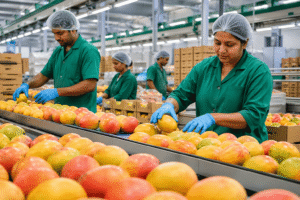
- Packaging details
- Delivery timeline
- Payment terms
- Shipping responsibility
This is where FOB and CIF come in they define who handles shipping, cost, and risk.
What Does FOB Mean in Mango Trade?
FOB (Free on Board) – Simple Explanation
In an FOB deal, the exporter is responsible until the mangoes are loaded onto the ship or plane at the origin port.
After that, everything becomes the buyer’s responsibility.
What the Seller Handles (FOB)
- Harvesting and packing
- Inland transport to port
- Export documentation
- Loading onto vessel
What the Buyer Handles (FOB)
- Freight (air or sea)
- Insurance
- Import clearance
- Local delivery in destination country
Why Buyers Choose FOB
Many experienced importers prefer FOB because:
- They can control shipping costs
- They already have logistics partners
- They can optimize freight timing
When FOB Works Best
- Buyer has strong logistics network
- Large, experienced importers
- Regular, high-volume trade
What Does CIF Mean in Mango Trade?
CIF (Cost, Insurance, Freight) – Simple Explanation
In a CIF deal, the exporter takes responsibility for delivering the mangoes to the destination port.
The price includes:
- Product cost
- Shipping cost
- Insurance
What the Seller Handles (CIF)
- Everything included in FOB
- Freight booking
- Insurance coverage
- Delivery to destination port
What the Buyer Handles (CIF)
- Import clearance
- Duties and taxes
- Local distribution
Why Buyers Choose CIF
CIF is popular among:
- New importers
- Buyers without logistics experience
- Smaller businesses
It simplifies the process they just receive the goods at their port.
When CIF Works Best
- Buyer wants convenience
- Smaller shipment volumes
- New market entry
FOB vs CIF – Key Differences That Matter
Cost Structure
- FOB: Lower upfront price, but buyer pays freight separately
- CIF: Higher price, but includes shipping and insurance
Control Over Shipment
- FOB: Buyer controls logistics
- CIF: Seller manages shipment
Risk Distribution
- FOB: Risk transfers earlier (once loaded)
- CIF: Seller manages more risk during transit
H3: Transparency in Pricing
FOB is often more transparent because freight costs are separate.
In CIF, freight is included so buyers must trust the seller’s pricing.
How Real Mango Deals Are Negotiated
Step 1 – Product Agreement
Both parties agree on:
- Variety (Sindhri, Chaunsa, etc.)
- Size and grade
- Packaging
Step 2 – Quantity and Schedule
Deals are structured in:
- Weekly shipments
- Full-season contracts
- Trial orders
Step 3 – Pricing Model (FOB or CIF)
This is where negotiation becomes important.
Buyer and seller decide:
- Who handles freight
- Which term suits both sides
Step 4 – Payment Terms
Common options include:
- Advance payment
- Letter of Credit (LC)
- Partial advance + balance
Step 5 – Shipment Execution
Once everything is agreed:
- Packing begins
- Documentation is prepared
- Shipment is dispatched
Common Mistakes in Deal Structuring
- Not clearly defining FOB or CIF terms
- Ignoring hidden costs (especially in CIF)
- Overpromising delivery timelines
- Poor communication on shipment updates
- Not understanding risk transfer points
These issues often lead to disputes even when quality is good.
Practical Tips for Buyers
Choose FOB if You Want Control
If you have logistics partners, FOB gives better cost control and flexibility.
Choose CIF if You Want Simplicity
If you’re new or want less hassle, CIF is easier to manage.
Always Break Down the Price
Even in CIF deals, ask for:
- Product cost
- Freight cost
- Insurance cost
This helps you understand margins.
Start with Trial Shipments
Before committing to large volumes, test the supplier with smaller orders.
Why Deal Structure Impacts Profit
Two buyers can purchase the same mangoes but make different profits just because of deal structure.
For example:
- One buyer manages freight efficiently (FOB) → lower total cost
- Another relies on CIF pricing → pays slightly more but saves time
The right choice depends on your experience, network, and business goals.
Final Thoughts
Bulk mango deals are not just about price they’re about structure, clarity, and risk management.
Understanding FOB and CIF is essential for anyone involved in international trade. These terms define who does what, who pays for what, and who takes the risk at each stage.
Once you understand this, negotiations become easier, decisions become smarter, and deals become more profitable.
In the end, a good deal is not just one that looks cheap it’s one that works smoothly from farm to final market.